

Lifecycle Marketing Is Not a Traffic Strategy. It’s a Revenue Pipeline.
Feb 24, 2026
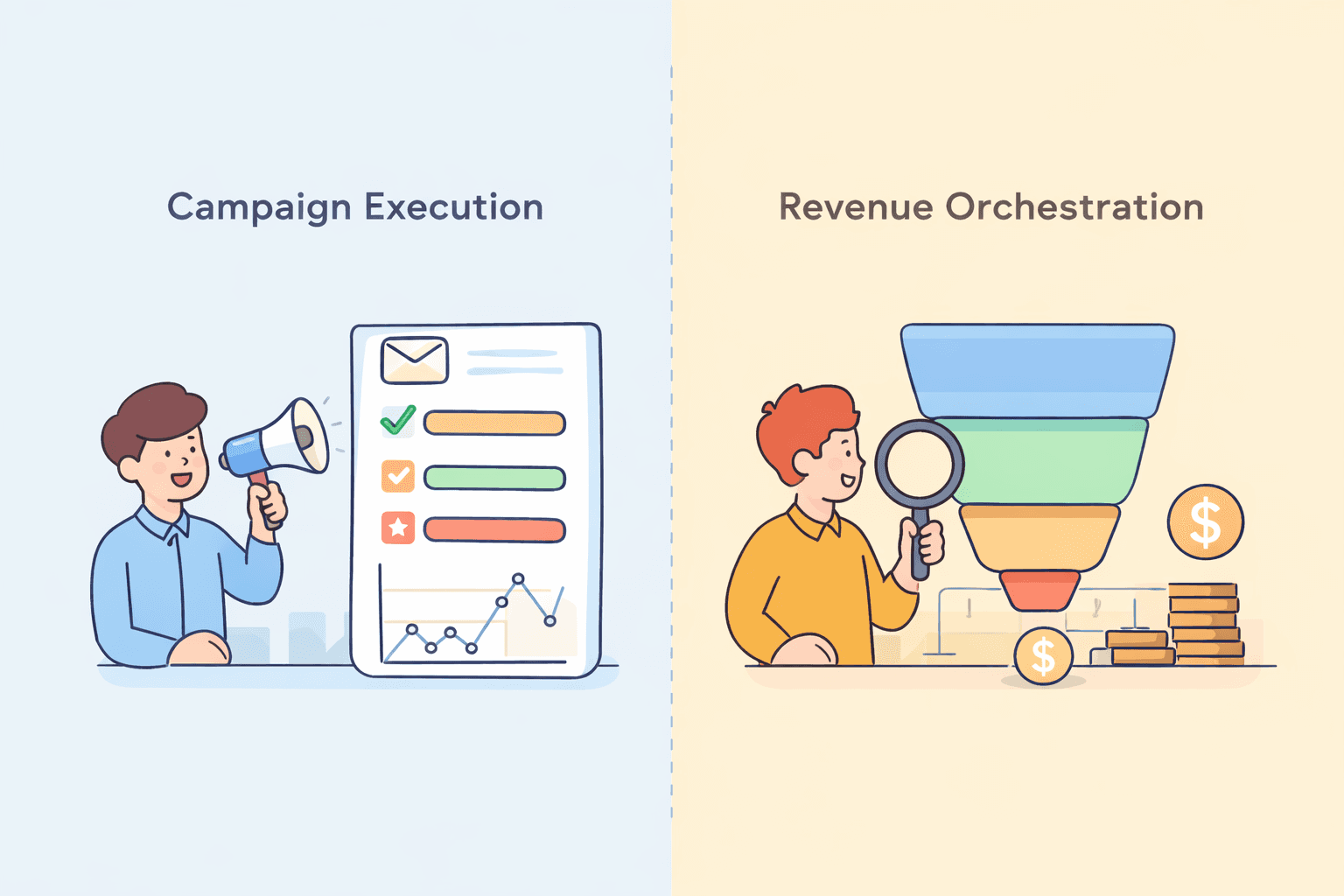
Lifecycle marketing is a revenue system, not a communication channel. When it's designed around revenue events instead of engagement metrics, it becomes pipeline. When it's measured by open rates and clicks, it stays outside the revenue conversation permanently. The difference is not performance. It's measurement design and system architecture.
Most companies treat lifecycle marketing as a communication channel.
It is not.
Lifecycle marketing is a revenue system.
If your lifecycle program is measured by open rates and clicks, it will always sit outside the revenue conversation.
If it is designed around revenue events, it becomes pipeline.
Why Is Lifecycle Marketing Measured Like a Traffic Channel Instead of Revenue Infrastructure?
Most lifecycle teams report open rate, click-through rate, unsubscribe rate, and engagement trends. These are engagement indicators, not revenue metrics. When lifecycle is measured like paid media, leadership evaluates it like paid media. The result is that email becomes a notification tool instead of a strategic revenue lever. The problem is not performance. It's measurement design.
Most lifecycle teams report:
Open rate
Click-through rate
Unsubscribe rate
Engagement trends
These are engagement indicators.
They are not revenue metrics.
When lifecycle is measured like paid media, it gets evaluated like paid media. Leadership asks:
“Does email even work?”
That question usually appears when:
Revenue attribution is unclear
Activation improvements are invisible
Retention impact is not quantified
Expansion events are not tracked back to lifecycle touchpoints
Email then becomes a notification tool. A reminder system. A promotional calendar.
It stops being strategic.
The problem is not performance.
The problem is measurement design.
What Does Lifecycle Marketing as a Revenue Pipeline Actually Mean?
Lifecycle marketing as a revenue pipeline means designing and measuring customer journeys around revenue-generating behaviors, not engagement metrics. Each lifecycle touchpoint is treated as a pipeline stage that influences activation, retention, expansion, or reactivation, and each stage is tied to a defined revenue event. Instead of asking "Did they open?", the system asks "Did this move them closer to revenue?"
That shift changes everything.
Campaign Execution vs. Revenue Orchestration
Campaign execution is message scheduling.
Revenue orchestration is behavior design.
Campaign execution asks: | Revenue orchestration asks: |
|---|---|
What are we sending this week? | What revenue behavior are we trying to trigger? |
What will improve open and click rates? | What friction blocks that behavior? |
How do we hit our send calendar? | What signal tells us it worked? |
Lifecycle connects acquisition cost to downstream monetization.
It sits between Growth, Product, Sales, and Finance.
It is the system that converts interest into lifetime value.
The Revenue Moments Framework
To operationalize lifecycle as pipeline, you need structure.
The Revenue Moments Framework maps lifecycle touchpoints to the behavioral events that materially influence revenue probability. Each stage is built around a revenue event, not a content calendar.
Stage 1: Onboarding
Revenue Behavior: Account setup completion, first value interaction
Goal: Reduce time-to-value
Stage 2: Activation
Revenue Behavior: First core feature usage, first transaction, first deposit
Goal: Prove product value
Stage 3: Habit Formation
Revenue Behavior: Repeat usage within defined time window
Goal: Increase retention probability
Stage 4: Expansion
Revenue Behavior: Upgrade, cross-sell, increased usage tier
Goal: Increase ARPU and LTV
Stage 5: Reactivation
Revenue Behavior: Return after inactivity threshold
Goal: Recover lost revenue potential
Notice what is missing.
Not “Welcome Email.”
Not “Feature Announcement.”
Not “Newsletter.”
Each journey is built around a revenue event.
The message exists to influence the event.
Not the other way around.
How to Identify Revenue Moments in Your Product
Revenue moments are the behavioral events that statistically increase retention, correlate with higher LTV, or predict churn. To find them, ask four questions, then use product analytics to validate the answers before building lifecycle journeys on top of assumptions.
Ask:
What behaviors statistically increase retention?
What actions correlate with higher LTV?
What early signals predict churn?
Where do users drop before converting?
Use:
GA4 funnel analysis
Product analytics (Amplitude, Mixpanel)
Snowflake cohort modeling
CRM lifecycle stage mapping
Your lifecycle program should sit on top of those insights.
Not guess them.
How to Attribute Revenue to Lifecycle Marketing
Revenue attribution for lifecycle marketing requires three foundations built into the system from day one: consistent UTM governance across every touchpoint, a standardized event tracking architecture with defined conversion events, and a connected attribution stack that links lifecycle interactions to behavioral and revenue events. Without these, lifecycle impact becomes invisible in dashboards and leadership conversations.
Here are the foundations:
1. UTM Governance
Every lifecycle touchpoint must have:
Consistent source naming
Medium classification
Campaign taxonomy
Version control
Without this, revenue attribution fragments across channels, and the lifecycle gets undercounted.
2. Event Tracking Architecture
You need:
Defined conversion events
Funnel stage event taxonomy
Clear primary revenue events
Consistent naming conventions
For example:
account_createdfirst_value_eventupgrade_completedsubscription_renewed
If these are not standardized, lifecycle impact cannot be measured reliably.
3. Connecting Touchpoints to Revenue Systems
A clean lifecycle attribution stack often includes:
GA4 for session and campaign attribution
CRM or CDP for user-level lifecycle stage tracking
Snowflake or BigQuery for cohort revenue modeling
Braze, HubSpot, or Intercom for message-level interaction data
Revenue connection happens when:
Lifecycle interaction → Behavioral event → Revenue event
If those links are broken, the lifecycle looks invisible.
Multi-Touch vs. Last-Touch Attribution for Lifecycle
Last-touch works when:
Revenue events are immediate
Conversion cycles are short
Multi-touch works when:
Activation is progressive
Retention is cumulative
Expansion happens over time
Lifecycle rarely operates in single-touch environments.
If you are measuring lifecycle with pure last-touch logic, you are undercounting its impact.
How Do You Turn Lifecycle Into a Forecastable Revenue Pipeline?
Sales teams forecast pipeline. Lifecycle teams should too. Map each lifecycle stage to a pipeline equivalent, then use historical activation rates and LTV correlation data to calculate the revenue impact of lifecycle improvements. When you can say "a 12% lift in activation increases LTV by 2.1x and generates X in attributable revenue," you are no longer speaking in marketing language. You are speaking in revenue language.
Lifecycle Stage | Revenue Outcome | Pipeline Equivalent |
|---|---|---|
Onboarding | Time-to-value | MQL Qualification |
Activation | First purchase | SQL Conversion |
Habit Formation | Retention lift | Closed Won Probability |
Expansion | Upgrade | Upsell Pipeline |
Reactivation | Recovery | Reopened Opportunity |
Example:
40% of users activate within 7 days
Activation increases LTV by 2.1x
Lifecycle interventions improve activation by 12%
That delta is attributable revenue impact.
Now you are speaking in revenue language. Not marketing language.
How to Report Lifecycle in Revenue Terms
Stop presenting open rates, click rates, and engagement trends. Start presenting activation rate lift, retention cohort improvement, churn reduction delta, expansion revenue contribution, and cost-to-serve reduction. These are financial levers, and leadership understands financial levers. Lifecycle also reduces paid acquisition dependency, support load, and churn volatility. Each of those has a dollar value attached to it.
Stop presenting: | Start presenting: |
|---|---|
❌ Open rates | ✅ Activation rate lift |
❌ Click rates | ✅ Retention cohort improvement |
❌ Engagement trends | ✅ Churn reduction delta |
✅ Expansion revenue contribution | |
✅ Cost-to-serve reduction |
Why Do Lifecycle Teams Get Excluded From Revenue Planning?
Lifecycle teams get excluded from revenue planning when reporting stops at engagement metrics, attribution is incomplete, lifecycle data is siloed from finance dashboards, and journeys are built around content calendars instead of revenue moments. The fix is structural: align lifecycle KPIs with revenue KPIs, partner with Data early, co-validate numbers with Finance, and present results in revenue terms.
Common reasons:
Reporting stops at engagement metrics
Attribution is incomplete
Lifecycle data is siloed from finance dashboards
Journeys are built around content calendars
No defined revenue moments
Lifecycle becomes “marketing support” instead of “revenue infrastructure.”
To change that:
Align lifecycle KPIs with revenue KPIs
Partner with Data early
Co-validate numbers with Finance
Present in revenue terms
What Are the Most Common Mistakes That Keep Lifecycle Out of the Revenue Model?
The most common mistake is optimizing for open rate instead of revenue events. Everything else flows from that. Without defined revenue moments, lifecycle has no strategic anchor. Without UTM governance and event taxonomy, attribution breaks. Without retention correlation analysis, leadership has no reason to treat lifecycle as infrastructure rather than support.
Optimizing for open rate instead of revenue events
No event taxonomy or inconsistent naming
Broken UTM governance
Treating lifecycle as a campaign calendar
No activation or retention correlation analysis
Siloed dashboards
No defined revenue moments
If lifecycle is not tied to a revenue behavior, it will never be treated as revenue infrastructure.
Most lifecycle teams are building great campaigns inside the wrong measurement system.
The campaigns aren't the problem. The frame is.
When you design around revenue moments instead of engagement metrics, lifecycle stops being a cost you justify and starts being a pipeline you forecast.
That's not a reporting change. That's a positioning change.
Build the system that earns the seat at the table. 📊
Frequently Asked Questions
Is lifecycle marketing the same as email marketing?
No. Email is a delivery channel. Lifecycle marketing is a behavioral revenue system that uses email, in-app messaging, push notifications, SMS, and product triggers, each mapped to a specific revenue moment in the customer journey.
How do you measure lifecycle marketing revenue?
By connecting lifecycle touchpoints to defined revenue events using consistent UTM governance, standardized event tracking architecture, and multi-touch attribution modeling across GA4, CRM, and data warehouse systems.
What is a revenue moment in lifecycle marketing?
A revenue moment is a behavioral event inside the customer journey that statistically increases revenue probability. Examples include first purchase, first core feature usage, upgrade, renewal, and return after inactivity. The Revenue Moments Framework organizes lifecycle journeys around these events.
Why do executives question lifecycle impact?
Because most lifecycle reporting stops at engagement metrics instead of tying interventions to activation lift, churn reduction, expansion revenue, or lifetime value. Without revenue-connected attribution, lifecycle looks like a cost center rather than a revenue driver.
What tools do you need to attribute revenue to lifecycle marketing?
At minimum: GA4 for campaign attribution, a CRM or CDP for user-level lifecycle tracking, an ESP like Braze or HubSpot for message-level data, and a data warehouse like Snowflake or BigQuery for cohort revenue modeling. The connection between these systems is what makes attribution reliable.
What is the Revenue Moments Framework?
The Revenue Moments Framework is a lifecycle design model that maps customer journey stages to revenue-generating behaviors instead of content or communication calendars. It covers five stages: Onboarding, Activation, Habit Formation, Expansion, and Reactivation, each anchored to a defined revenue event and measurable outcome.