

Your Buyer's Brain Has Changed: Why SEO Now Means 'Solution Engine Optimization' and How to Win with It.
Oct 8, 2025

Over the past three years, we've witnessed an exponential change in how the world finds information. The era of patiently clicking through a dozen blue links on Google is fading. We're now in the age of AI, where buyers ask specific, complex questions and expect direct, comprehensive answers. This isn't just a trend; it's a fundamental rewiring of the buyer's brain.
This shift became crystal clear to me during a recent deep dive I had the pleasure of undertaking with degreed.com. The project sent me down a rabbit hole, analyzing how B2B leaders are truly using their websites not just as sales tools, but as powerful demand-capture engines.
My findings were fascinating. The most successful B2B websites I've come across all have one thing in common: they practice what I call "transparent marketing." They obsess over answering the specific, nuanced questions their audience has. They aren't afraid to back up their claims with direct comparisons, and they build incredible trust by being honest—even if it means admitting a competitor might be a better fit for a problem they don't solve. They know that this radical transparency is precisely what convinces the right customers that they are the better option.
So, my goal in this article is not to give you a simple checklist. My goal is to challenge your idea of what a modern, demand-focused website should be. I want to share the insights I've gathered and show you how to leverage these powerful ideas to, I believe, drastically improve your results.
The Paradigm Shift: From Search Engine to Solution Engine
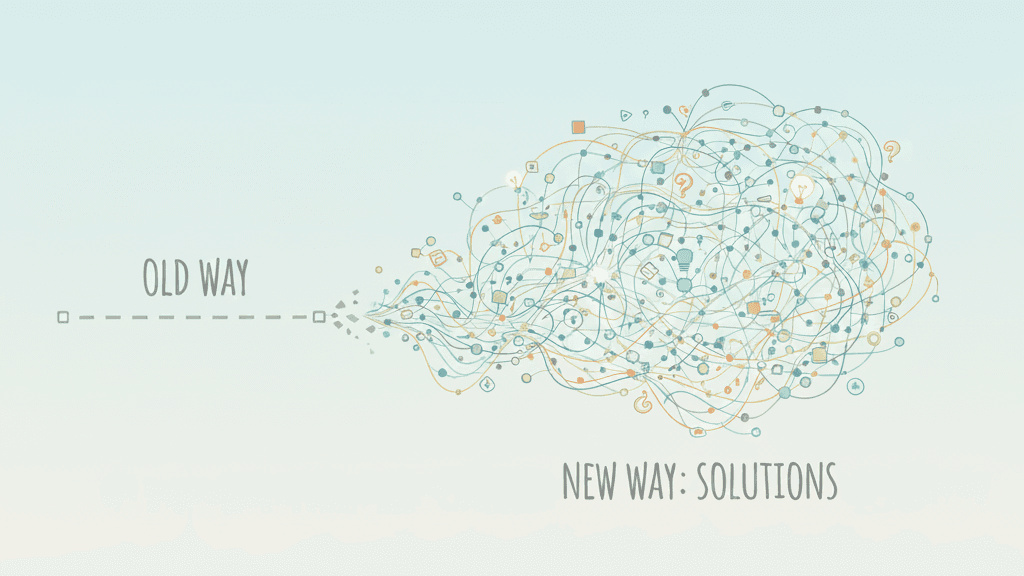
For two decades, the rules of the game were simple: figure out what keywords your buyers used, create content around them, and climb the search rankings. We all learned to play this game well, but the game board itself is being replaced.
The internet's gatekeepers, like Google, are no longer acting like digital librarians, handing you a list of books (links) and letting you do the reading. Fueled by AI, they are now becoming digital consultants. They read all the books themselves and deliver a synthesized, direct answer to the user.
This evolution is governed by two new, critical concepts:
AEO (Answer Engine Optimization): This is the baseline for survival. It means structuring your content so clearly and authoritatively that an AI can easily recognize it as a factual, trustworthy answer to a specific question. Think of the featured snippets or "People Also Ask" boxes on Google. If you're not optimized for this, you're not even in the consideration set for the AI.
GEO (Generative Engine Optimization): This is the next frontier, where market leaders will be decided. It’s about optimizing your content not just to be found, but to be used and cited by generative AI models like those powering Google's SGE, Perplexity, and ChatGPT. This requires more than just clear facts; it demands original insights, unique data, and the strong, authoritative point of view that comes from the "transparent marketing" I mentioned earlier.
What does this mean for a B2B leader? The stakes have been raised dramatically. It's no longer about fighting for a spot on the first page. If your website is not the source the AI trusts to form its answer, then for all practical purposes, you are invisible. A competitor's opinion becomes the AI's answer, and your voice is never heard.
This new reality can be daunting, but it also presents an incredible opportunity for those willing to adapt. If you can become the most trusted resource in your niche, you don't just win a ranking; you become the definitive solution in the eyes of both your future customers and the AI that guides them.
The Demand Capture Framework: 3 Ways to Remodel Your Website Today

Understanding the shift to a solution-first world is one thing; acting on it is another. Based on my research and analysis, I’ve found that the B2B leaders winning in this new landscape have all remodeled their digital presence around three core pillars.
Pillar 1: Go from "Keyword-Focused" to "Problem-Obsessed"
The old model was to target a high-volume keyword and write a single piece of content to rank for it. This strategy is now too broad to attract high-intent buyers. Today's decision-makers don't search with keywords; they search with questions that represent deep-seated business problems. Your job is to become obsessed with answering those questions better than anyone else.
The Old Way: Writing a 1,000-word blog post titled "The Benefits of Project Management Software."
The New Way: Building a comprehensive "Project Management Learning Hub." This hub doesn't just target one keyword; it aims to solve the entire problem set. It would include interconnected articles answering specific, long-tail questions like:
This is how you optimize for AEO and GEO. You're not just a result; you are the definitive resource.
Pillar 2: Go from "Showcasing Features" to "Demonstrating Authority"
A feature list on your website is just a claim. In a market full of noise, claims are cheap. Authority, on the other hand, is earned. Decision-makers don't buy features; they buy the proven expertise and trust that your solution will actually solve their problem. This is where "transparent marketing" comes into play.
The Old Way: A "Features" page with a bulleted list of what your product can do.
The New Way: Prove your expertise so convincingly that the sale becomes the logical next step.
Pillar 3: Go from a "Digital Brochure" to a "Conversion Engine"
The most authoritative content in the world is useless if it doesn't guide the reader toward the next step. Too many B2B websites treat their content and their conversion funnels as two separate things, with only a "Contact Us" button to bridge the gap. In a demand capture model, every piece of content is an opportunity to convert intent into action.
The Old Way: A single, generic "Request a Demo" button in the top corner of your site.
The New Way: Place high-value, contextual calls-to-action (CTAs) directly within your content, matching the offer to the reader's mindset at that exact moment.
Each of these pillars works together to transform your website from a passive digital brochure into an active, 24/7 engine for capturing your ideal customers.
Three Challenges You Must Overcome

Adopting this framework is more than a marketing tactic; it's an organizational philosophy shift. Before you dive in, you need to be prepared for a few uncomfortable truths. Based on my observations, companies that struggle with this model often stumble on one of these three challenges.
Challenge #1: Your Metrics Are Measuring the Wrong Things
The old world of SEO conditioned us to obsess over vanity metrics: keyword rankings, raw traffic, and the sheer volume of "Marketing Qualified Leads" (MQLs). A demand capture model requires a more sophisticated view of success. Ranking #1 for a keyword is useless if it doesn't attract high-intent buyers. A flood of MQLs is a liability if the sales team has to waste time disqualifying them all.
The Challenge: You must shift your focus from volume to value. This means measuring things like pipeline created from your content, conversion rates on high-intent pages, and the sales cycle velocity of the leads who engaged with your authoritative content. It requires deep alignment between marketing and sales on what a truly qualified prospect looks like.
Challenge #2: Your Experts Aren't Your Writers (And Vice Versa)
In the old model, content was a commodity. You could hire a freelance writer, give them a keyword, and get a passable article. That approach is now a recipe for invisibility. The deep, problem-solving content that AI engines and savvy buyers crave cannot be faked; it must come from genuine subject matter expertise.
The Challenge: You must build a culture where content is treated as a core product, not a marketing checklist item. This means your marketing team's most important skill is no longer just writing, but interviewing. They need to become expert facilitators, pulling the invaluable knowledge out of the heads of your best sales engineers, product managers, and strategists, and then shaping that expertise into compelling content.
Challenge #3: This Is a Marathon, Not a Sprint
Building a brand and becoming the trusted authority in your space doesn't happen overnight. A keyword-focused campaign might yield a temporary traffic boost, but the authority-building required for demand capture is a long-term investment. The results are not linear; they compound over time, creating a durable competitive advantage that is incredibly difficult for others to replicate.
The Challenge: You need to secure genuine leadership buy-in and have the patience to see the strategy through to completion. The goal isn't a quick spike in leads for the next board meeting; it's to build a gravitational pull for your brand that attracts a steady stream of your ideal customers for years to come.
Confronting these challenges head-on is what separates the companies that win the future from those that are left wondering why their old playbook stopped working.
Conclusion: Your Website is Not a Cost Center; It's Your #1 Salesperson

The digital landscape has fundamentally changed. The passive searcher of yesterday has been replaced by the active problem-solver of today, and the AI-driven tools they use are getting smarter by the second. In this new reality, clinging to the old rules of keyword stuffing and feature listing is no longer a viable strategy—it's a slow march toward invisibility.
The shift to a Demand Capture model, built on a foundation of "transparent marketing" and a deep obsession with solving your customers' problems, is the path forward. It's about transforming your website from a static digital brochure into your most effective, hardest-working salesperson—one that works 24/7 to build trust, demonstrate authority, and attract your ideal buyers.
The challenges are real, but the opportunity is immense. The companies that embrace this change will build a defensible moat around their business, becoming the go-to resource that both customers and AI turn to.
My goal today was not to give you a checklist, but to challenge your thinking. The only question left is: are you ready to start building?
A Note on Inspiration and Empowerment

I want to clarify that this is not a sponsored post.
I do, however, want to extend a sincere thank you to the team at Degreed.
A recent opportunity I had with them was the catalyst for this entire article. It’s fitting that a company whose entire platform is built on the idea that valuable learning happens everywhere would, in turn, spark a deep learning journey for me.
Degreed helps teams move beyond compliance-based training and empowers them to build real skills from the articles, videos, and projects they engage with every day.
That experience directly inspired me to develop the insights I've shared here.
This experience also solidified my belief that corporate learning should not just be a compliance checkbox, but an engine for empowerment. If you're a leader who believes in empowering your team to expand their horizons and build the skills they need to succeed, then
I highly recommend checking them out at https://degreed.com/
Thank you again for the inspiration.