

Your SEO Content Already Works. Here's How to Make AI See It Too.
Feb 14, 2026
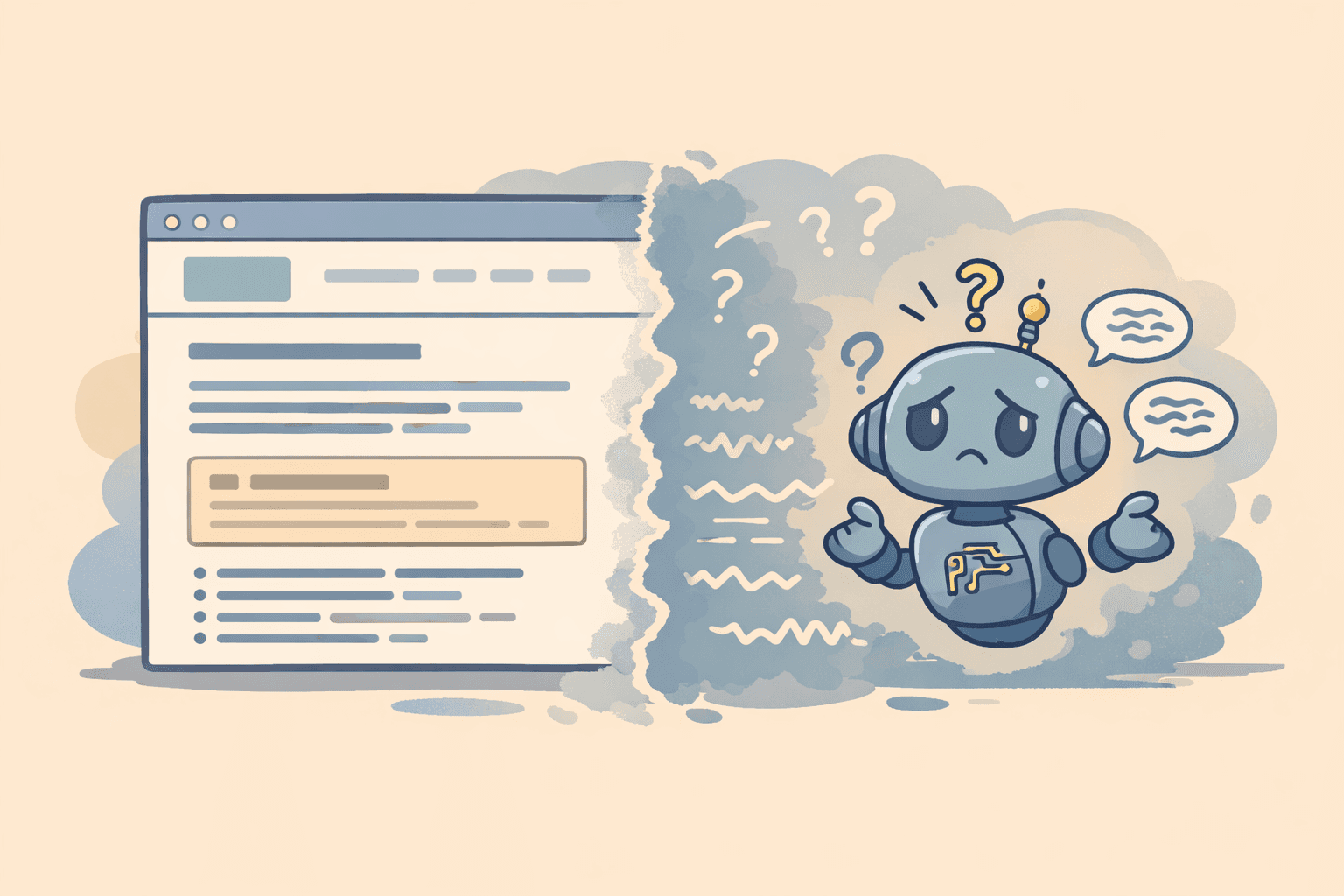
To optimize content for AI search, you don't need to rewrite it. You need to retrofit it. Most pages fail to get cited by AI systems, not because the content is weak, but because the structure isn't built for extraction. AI models chunk pages into sections and evaluate each one independently. If your answers are buried, your headings are vague, or your schema is missing, the model moves on regardless of how good your content actually is.
You don't have a content problem. You have a parsing problem.
I've audited enough sites this year to see the same pattern.
3,000-word guides. Strong rankings. Solid backlinks. Real authority.
Then I ask ChatGPT or Perplexity the exact same question the page answers.
The brand disappears.
Not because the content is weak. Because the structure isn't built for extraction.
Ranking used to be the win. Now being cited is.
And most content libraries built over the last decade weren't designed for that.
What Changed About How People Search for Answers?
The shift is structural: people now get full answers inside AI interfaces instead of clicking through to websites. Zero-click searches hit 69% in 2025. AI Overviews appear in over 60% of search results, up from just 6.5% at the start of that same year. ChatGPT serves 800 million users weekly, and referral traffic from AI platforms to websites grew 357% year-over-year. The content that powers those answers gets cited. Everything else gets skipped, not penalized, not outranked, just skipped.
For years, the equation was simple.
Rank on page one > Get the click > Convert the traffic.
That system is breaking, and the data backs it up.
Zero-click searches hit 69% in 2025. - Search Engine Roundtable
AI Overviews now appear in over 60% of search results, up from just 6.5% in January of that same year. - BrightEdge: "The Ultimate Guide to Google AI Overviews"
ChatGPT serves 800 million users weekly. Referral traffic from AI platforms to websites grew 357% year-over-year. - Business Insider
People aren't clicking ten blue links anymore. They're getting full answers inside the search interface, inside a chat window, or read aloud by a voice assistant.
The content that powers those answers gets cited. Everything else gets skipped. Not penalized. Not outranked. Skipped. That's a different problem, and it requires a different fix.
Is SEO Dead, or Just Incomplete?
SEO is not dead. It's incomplete. AEO (Answer Engine Optimization) and GEO (Generative Engine Optimization) are not replacements for traditional SEO. They're a structural upgrade layer built on top of it. You still need clean technical infrastructure, strong internal linking, topical depth, crawlable architecture, and fast load times. When you add extraction-ready structure on top of that foundation, you improve both rankings and AI citation simultaneously.
A lot of people are framing this as SEO versus AEO (Answer Engine Optimization) or GEO (Generative Engine Optimization).
That's lazy thinking.
You still need clean technical infrastructure, strong internal linking, topical depth, crawlable architecture, and fast load times. A great foundation feeds both Google and AI systems.
AEO is not a replacement. It's a structural upgrade layer. You're not replacing your engine. You're upgrading the wiring so it works with the systems that are actually delivering answers to people right now.
When you structure content for extraction, you improve traditional SEO too. Cleaner headings improve scan depth. Direct answers improve engagement metrics. Better internal linking strengthens crawl paths. Schema improves rich result eligibility.
The sites winning right now are not choosing between ranking and citation. They're designing for both.
Why Do AI Models Ignore High-Quality Content?
AI models ignore good content when it isn't structured for extraction. LLMs don't read pages the way humans do. They chunk pages into discrete sections and evaluate each section independently against one silent question: "Is this safe to quote?" If the answer is buried, the heading is vague, or the structure is ambiguous, the model moves to a source that makes extraction easier, regardless of which one is more authoritative.
This is the part that frustrates people. You have a comprehensive guide that covers a topic better than almost anything else on the internet. It ranks well. It gets traffic. But when someone asks an AI the same question, your content is invisible.
Here's why LLMs don't read content the way humans do:
LLMs don't scroll. They chunk.
They break your page into sections and evaluate each one independently.
Every section silently answers one question: "Is this safe to quote?"
If the answer is no, the model moves on.
Here are the specific signals that trigger that:
Answers come too late. Most pages open with background, context, and framing. AI wants the answer immediately. If your core point is buried three paragraphs deep, the model skips to a source that leads with clarity.
Headings don't map to real questions. "Key Considerations" means nothing to a model. "How Does X Work?" is extractable. Your headings should mirror the way someone would ask the question out loud, because that's exactly how people interact with AI search tools.
Weak entity signals. AI models build understanding through entities: specific names, concepts, products, frameworks, and relationships. If your page talks in abstractions instead of precise terminology, it becomes harder for the model to map your content to a query with confidence. Precision beats vagueness every time.
No machine-readable structure. FAQ schema. Article schema. HowTo schema. Without these, the model has to infer what your content is. Inference introduces risk. Risk reduces citation. Pages using FAQ or HowTo schema are significantly more likely to be cited in AI-generated answers.
Stale trust signals. No update date. No author attribution. Outdated statistics. Recency is a weighting factor. One analysis found that ChatGPT prioritizes recent content over well-written older content. A strong guide from 2022 can lose to a mediocre article published last week if the freshness signals aren't there.
None of these requires new content. They require structural discipline applied to what you already have.
What extraction failure looks like in practice:
Before | After | |
|---|---|---|
Heading | "Our Approach to Customer Retention" | "How Do You Reduce Churn in the First 30 Days?" |
Opening | Two paragraphs of company philosophy before mentioning a single tactic | "The fastest lever is behavior-triggered onboarding sequences that surface value before the trial window closes." |
Result | Model skips section | Model extracts and cites |
Same content. Same expertise. Completely different extractability.
Do You Really Need to Rewrite Everything?
No. And this is where most teams waste money.
They assume AI visibility requires brand new "AI-optimized" articles. It doesn't.
If you've been investing in SEO for any meaningful amount of time, you already have the hard part done. You have topical authority. You have indexed pages. You have traffic history. You have depth on subjects your audience cares about.
That library is your biggest asset. The mistake is thinking you need to tear it down. You don't. You need to retrofit it.
Think of it like a building. The foundation and structure are solid. But the electrical system was designed for a different era. You don't demolish the building. You rewire it so it works with modern infrastructure.
Same idea here.
Keep the substance. Add the structure AI needs to find it, parse it, and cite it.
How Do You Retrofit Content for AI? (The Practical Framework)
To retrofit content for AI search, work through six steps: audit your top-performing pages in Search Console, add 40-60 word answer blocks at the top of each section, rewrite vague headings as questions that mirror real search queries, implement Article or FAQ schema markup, build internal linking clusters around core topics, and refresh freshness signals including update dates and current statistics. You don't need a six-month initiative. Start with five pages.
Here's the operating model:
Step 1: Audit your top performers.
Open Google Search Console. Find the pages with the highest impressions and clicks. These are your best candidates because they already carry authority that AI systems can build on.
Also, look for pages with high impressions but low click-through rates. These are most at risk. AI Overviews are already pulling answers from these pages without sending the click.
Step 2: Add concise answer blocks.
For every major section, write a direct answer in the first 40 to 60 words below the heading. Make it clear, specific, and self-contained. Someone reading just that paragraph should understand the core point without needing the rest of the section.
This doesn't mean dumbing down your content. It means front-loading value. Go deep after the answer block. But lead with the point.
Step 3: Restructure headings as questions.
Replace vague headers with question-based headings that match real search queries.
Instead of "Implementation Strategy," use "How Do You Implement This Without Disrupting Existing Workflows?"
Instead of "Benefits," use "What Results Can You Expect in the First 90 Days?"
This signals to the AI exactly what each section answers, aligning your content with conversational queries.
Step 4: Implement schema markup.
At a minimum, add Article schema to every content page. For Q&A content, add FAQ schema. For instructional content, add HowTo schema.
Schema is the difference between AI having to interpret your content and AI being told exactly what your content is. Tools like RankMath, Yoast, or Google's Structured Data Markup Helper handle most of it without a developer.
Step 5: Build internal linking clusters.
AI systems evaluate topical authority by looking at how your content connects. A single page on a topic is a data point. Ten interconnected pages on related subtopics is an authority signal.
Group existing content into clusters around core topics. Link each page to related pages with descriptive anchor text. This tells AI models your site has depth on the subject.
Step 6: Update freshness signals.
Add a visible "Last Updated" date to every page you retrofit. Refresh outdated statistics and references. Update author bios with relevant credentials.
This is one of the easiest wins. Update the date, refresh the stats, and you've signaled to AI systems that this content is current and maintained.
What Happens to Brands That Don't Retrofit Their Content?
Brands that don't retrofit their content lose citation authority to competitors who do, often without any visible change in traditional rankings. Your Google rankings stay flat. Traffic might even hold for a while. But AI systems start citing your competitors instead of you at the exact moment someone asks the question your content answers. That visibility gap compounds over time and becomes harder to close.
Your competitor retrofits five core pages. AI starts citing them instead of you. Nothing changes in your Google rankings. Traffic might even stay flat for a while.
But visibility shifts. You lose authority inside AI summaries. You lose brand reinforcement at the moment someone is asking the exact question your content answers. You lose the "source" position. And that compounds.
AI Overviews went from 6.5% to over 60% of searches in under a year. The window to get ahead is open right now, but the longer you wait, the more ground your competitors gain by simply making their existing content more extractable than yours.
The good news: retrofitting is faster and cheaper than creating from scratch. The authority already exists. You just need to make it readable.
Where Do You Start Optimizing Content for AI This Week?
Start with five pages this week. Open Search Console, identify your highest-impression pages, and apply all six steps to each one: question-based headings, answer blocks, schema, freshness signals, and internal links. Set a 30 to 60 day window and track changes in AI Overview inclusion, branded search volume, and referral traffic from AI platforms. Once you see results, scale the process across your content library.
Open Search Console. Find the pages with the highest impressions. Then for each one:
Rewrite headings as questions people actually ask
Add a 40 to 60-word answer block at the top of each section
Implement FAQ or Article schema
Add a visible "Last Updated" date
Check internal links to related content and fill any gaps
Five pages. A few hours of work per page. Measure over the next 30 to 60 days. Watch for changes in AI Overview inclusion, branded search volume, and referral traffic from AI platforms.
Once you see results, scale across your content library. Prioritize by traffic and business value. Build it into your regular content maintenance workflow.
Your Content Already Works. Now Make AI See It.
The content library you've built over the years isn't a liability. It's leverage.
But leverage only works if the systems delivering answers to people can actually read what you've built.
The brands that figure this out won't just show up in search results. They'll be the source AI cites when it answers the question. Not because they wrote more content. Because they made their existing content extractable.
Ranking got you visibility. Extraction earns you authority.
Now design for both. 🤓
Frequently Asked Questions
What is AEO, and how is it different from SEO?
AEO (Answer Engine Optimization) is the practice of structuring content so AI systems can extract and cite it directly in generated answers. SEO focuses on ranking in traditional search results. AEO is not a replacement for SEO. It's a structural layer built on top of a strong SEO foundation, designed to make content parseable by LLMs, AI Overviews, and voice assistants.
Why is my well-ranked content not being cited by AI?
High rankings don't guarantee AI citation. LLMs evaluate content for extractability, not just authority. If your answers are buried mid-paragraph, your headings are vague, your schema is missing, or your freshness signals are stale, the model will skip your page for one that's easier to quote, even if yours is more comprehensive.
How do I optimize existing content for AI search without rewriting it?
The retrofit approach covers six steps: add 40-60 word answer blocks under each heading, rewrite vague headings as questions, implement Article or FAQ schema, build internal linking clusters, and refresh update dates and statistics. You keep the existing content and add the structural signals AI needs to find, parse, and cite it.
What schema markup should I add for AI visibility?
Add Article schema to every content page as a baseline. For pages with a question-and-answer structure, add an FAQ schema. For instructional or step-by-step content, add HowTo schema. Schema removes the need for AI to infer what your content is, which reduces citation risk and improves extractability.
How long does it take to see results after retrofitting content for AI?
Most practitioners report measurable changes within 30 to 60 days of retrofitting. Track AI Overview, including branded search volume and referral traffic from AI platforms like ChatGPT and Perplexity. Start with five high-impression pages, measure the results, then scale across your content library.